

Our Mission & Vision

We enhance the value of individual EU Agencies and Joint Undertakings by deepening their collaboration, with the objective of providing EU citizens, businesses and institutions the right foundation to achieve their priorities. In doing so, we represent a cost-efficient, agile and impactful administrative backbone for the implementation of Union policies.

Through our combined knowledge and actions, we contribute to the implementation of EU policies and strive for the development of a more sustainable, inclusive and competitive Europe for the benefit of all EU citizens.
Governance and structure
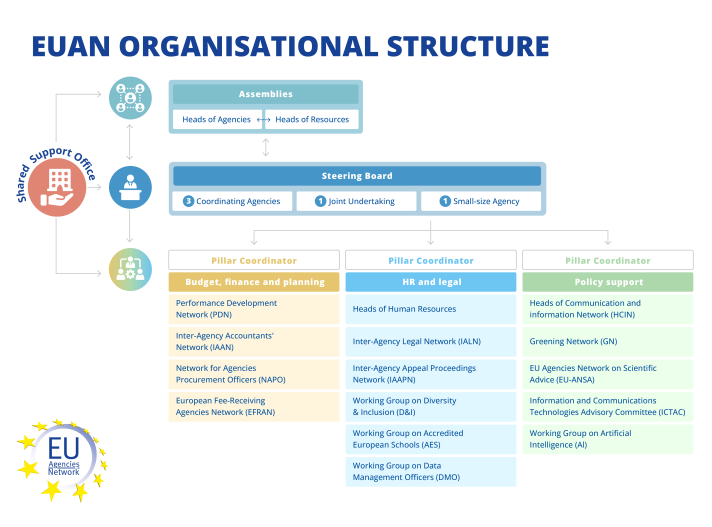
The EU Agencies Network (EUAN) operates through a structured governance model to enhance collaboration, efficiency, and decision-making across its members. Key bodies include:
- Assembly of the Heads of Agencies (HoA) – the main decision-making body, setting strategic direction and adopting common positions
- Assembly of the Heads of Resources (HoR) – focusing on resource management and operational matters
- Steering Board – supporting the Coordinating Agency and ensuring continuity in leadership
- Coordinating Agency – leading EUAN activities for a one-year term
- Pillar Coordinators – overseeing specific work areas such as budget and finance, HR and legal, and EU policy support
- Sub-Networks (SN), Working Groups (WG) and Task Forces (TF) – fostering technical cooperation on specialised topics
- EUAN Shared Support Office (SSO) – providing operational and administrative assistance.
Coordinating Agency and Steering board
Every year, an Agency chairs the EUAN and sets the priorities for the coming year. The European Labour Authority (ELA) took over the Network’s coordination on 1 March 2026. The European Chemicals Agency (ECHA) is due to take on the coordination role in March 2027.
The Coordinating Agency leads the EUAN for one year, organises meetings, and represents the Network externally.
The Steering Board includes outgoing, present, and incoming Coordinating Agencies, along with a small size Agency and a Joint Undertaking.
Governing bodies
The EUAN is governed by the Assemblies of Heads of Agencies (HoA) and Heads of Resources (HoR) who meet at least twice a year.
Working bodies
Thematic Sub-Networks, Working Groups and Task Forces implement the EUAN strategy and annual work programmes and enhance inter-agency collaboration and communication. Their work results in tangible deliverables that benefit their work and EU citizens.
Pillar Coordinators manage work in key policy areas, ensuring alignment with EUAN’s strategic priorities. They oversee activities within their designated pillar, including budget and finance, HR and legal, and EU policy support, and coordinate efforts across Sub-Networks, Working Groups, and Task Forces. Pillar Coordinators also play a key role in fostering collaboration, identifying synergies, and reporting progress to the Steering Board and the Assembly of the Heads of Agencies.
The day-to-day operations are led by the Steering Board, with the support of the EUAN Shared Support Office (SSO) in Brussels.
Shared Support Office (SSO)
The SSO represents the institutional memory of the Network and serves as a communication and connection hub between the EU institutions and the EUAN members, in addition to providing essential support and advisory services to the EUAN working and governance bodies.
The SSO performs a large range of tasks:
- coordinates the day-to-day governance of the Network under the lead of the Coordinating Agency and the Troika
- supports the activities carried out in thematic Sub-Networks, Working Groups and other Task Forces
- nurtures fruitful relationships with EU institutions and bodies, such as: the European Commission's department for budget (DG BUDG), the department for Human Resources (DG HR) and the Secretariat General (SG), the European Parliament’s Conference of the Committee Chairs (CCC), the Budgets Committee (BUDG) and Budgetary Control Committee (CONT), several Working Parties of the Council and the European Court of Auditors (ECA).
The SSO is composed of the following staff members:
- Julien Taieb, Head of Office
- Marta Aranega-Gallart, Inter-institutional Officer, Human Resources
- Martina Nagyova, Inter-institutional Officer, Budget & Finance
- Aurimas Kisielius, Shared Services Officer
- Anna Iovchu, Communication Officer
- Two trainees.
Strategy / Work programme
The strategy of the EUAN aims to support the Agencies and Joint Undertakings:
- To develop a modern, agile and flexible administration capable of supporting the greening and digital transitions
- To adopt innovative management and working methods to attract and retain talents
- To foster synergies and efficiency gains leading to time and cost savings
The new multiannual strategy (2021-2027) is built around two main pillars where EU Agencies and JUs are committed to join forces and mutualise efforts:
1. EU Agencies & Joint Undertakings as a role model for administrative excellence
2. EU Agencies Network as a valued institutional partner
EUAN Work programme
From 1 March 2026 to 28 February 2027, the European Labour Authority (ELA) chairs the EU Agencies Network (EUAN).
The EUAN Work Programme 2026–2027, coordinated by ELA, follows the priorities of the EUAN Strategy 2021–2027 and builds on the achievements of the previous Chairs. The programme focuses on improving administrative practices, strengthening cooperation across the Network and promoting EUAN’s role within the EU institutional framework.
The programme also takes into account key EU developments, including the European Commission’s large-scale review of public administration, negotiations on the Multiannual Financial Framework (MFF) 2028–2034, and ongoing digital transformation across the EU public sector.
Key priorities at a glance:
- Enhance administrative excellence and cooperation across EU Agencies and Joint Undertakings
- Support the digital transformation of EU public administration by sharing good practices on digital tool and AI
- Contribute to discussions on the future of EU public administration and EU budget, as well as the role of Agencies and JUs in implementing EU policies
- Foster cooperation with EU institutions and increase the visibility of the Network

The 2026-2027 Work Programme guides the work of the EUAN during the chairmanship of ELA.